
Fear-Based Leadership Style
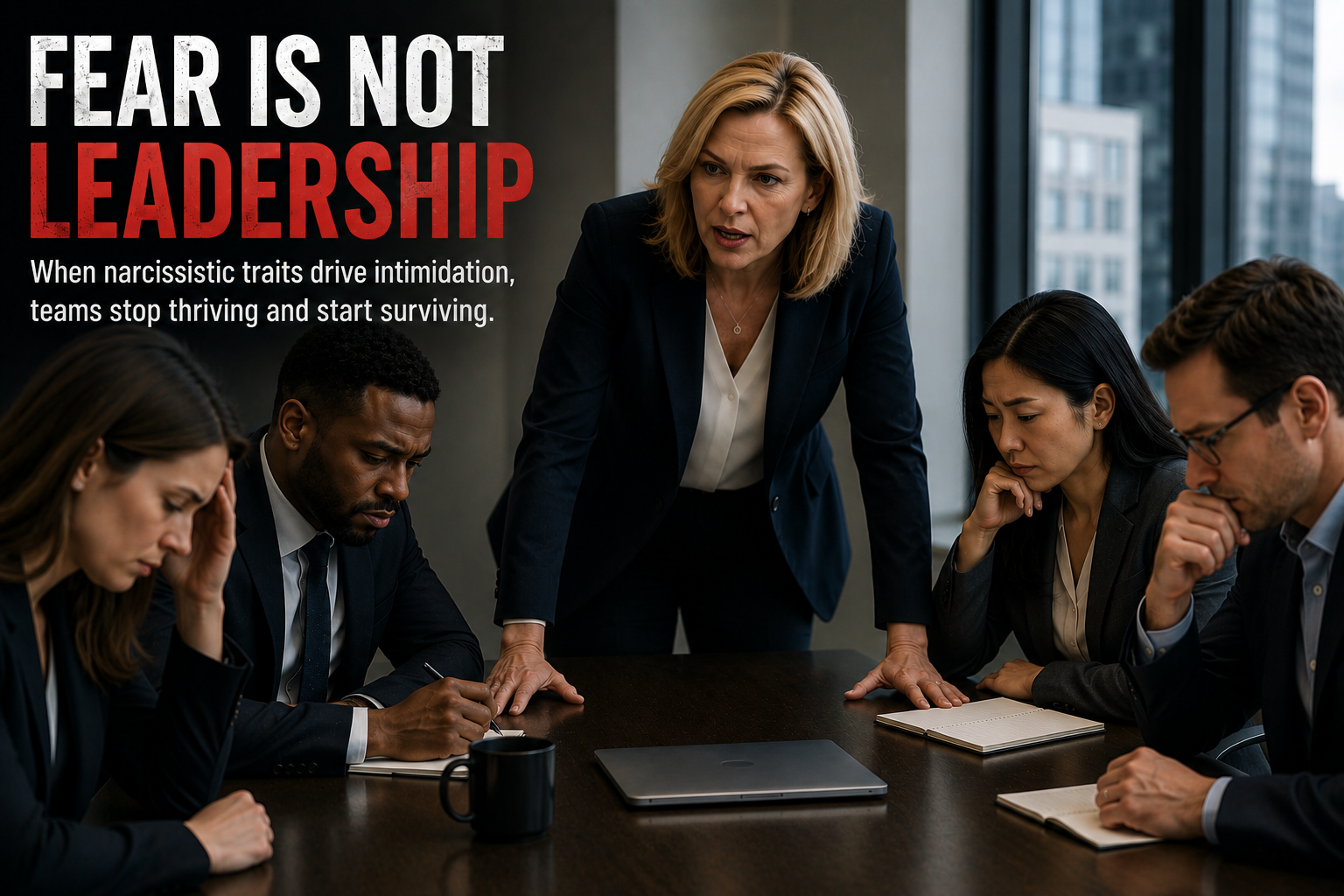
A senior executive walks into the weekly leadership meeting. The room immediately changes. Conversations stop. Team members glanced down at their laptops. No one wants to be the first to speak.
The executive begins asking questions, not to gather insight, but to establish control.
“Why wasn’t this done exactly the way I asked?”
“Who approved this?”
“Should I attend your team meeting to make it clear what I want from your department.
One manager attempts to explain a challenge the team encountered. The executive cuts him off mid-sentence and responds sharply in front of the group: “Excuses are the reason average people stay average.”
After the meeting, employees quietly message each other trying to determine who might be blamed next. No one discusses innovation anymore. No one challenges ideas. The team has learned that survival, not creativity, is the safest path forward.
Unfortunately, this type of fear-based leadership is more common than many organizations realize.
While not every intimidating leader has a diagnosable condition, many fear-driven leadership environments reflect traits associated with narcissistic personality disorder, particularly when leaders rely on intimidation, humiliation, control, and dominance to maintain authority. Many organizational psychologists would suggest that the single strongest alignment with the fear-based leadership style is narcissistic personality disorder. This personality disorder uses fear and intimidation for;
- ego protection,
- dominance maintenance,
- image preservation,
- and control over perceived threats to status.
At first glance, these leaders may appear confident, decisive, and commanding. Organizations sometimes mistake their intensity for strength. But beneath the surface, fear-based leadership often stems from a deeper need to protect ego, preserve status, and avoid vulnerability.
For these leaders, disagreement can feel like disrespect. They often operate in extremes, black and white thinking. You are either good or bad, he likes you or hates, no gray areas. Feedback often feels like an attack. Delegation becomes difficult because trust is limited to a small inter circle of enablers. Therefore, control becomes psychologically comforting. Unfortunately, these leaders also lack high levels of self-awareness which makes getting them to recognize this behavior more difficult.
As a result, intimidation becomes a leadership tool.
This intimidation may not always involve yelling or explosive anger. Sometimes it appears through sarcasm, public criticism, dismissive language, unrealistic expectations, micromanaging senior leaders or creating an environment where employees constantly feel they are “walking on eggshells.”
The emotional impact on employees is significant. Research from American Psychological Association and studies on psychological safety consistently show that fear suppresses communication seriously impacts creativity, collaboration, and trust. Employees in intimidation-based environments often become highly risk-avoidant. Instead of focusing on innovation and performance, energy shifts toward self-protection.
Over time, several organizational warning signs begin to emerge:
- High turnover among top performers
- Reduced employee engagement
- Lack of honest upward feedback
- Decision-making bottlenecks
- Increased burnout and anxiety
- Teams that comply outwardly but disengage internally
Ironically, fear-based leaders often believe intimidation improves accountability and performance. In reality, fear may create short-term compliance, but it rarely produces long-term commitment, trust, sustainable excellence important to me is the loss of long-term loyalty to the organization.
Healthy leadership requires influence, not intimidation.
Strong leaders create accountability while still maintaining psychological safety. They challenge employees without humiliating them. They build trust rather than dependence. Most importantly, they understand that leadership is not about controlling people through fear; it is about creating conditions where people can perform at their best.
Organizations also carry responsibility in this dynamic
Too often, companies reward results while ignoring the destructive interpersonal behaviors used to achieve them. A leader who consistently delivers numbers may be protected despite creating toxic team cultures. When organizations tolerate intimidation because “the leader gets results,” they unintentionally reinforce fear as an acceptable leadership strategy. I consider the organization “toxic culture enabler”
The cost eventually surfaces in the form of low morale, retention, disengaged culture, and performance.
The most effective leaders do not need fear to establish authority. They lead with clarity, consistency, emotional intelligence, and trust. Employees should feel challenged by leadership, not psychologically threatened by it.
Because when fear becomes the primary management strategy, leadership stops being about developing people, and starts becoming about controlling them.

About Dr. Ollie G. Barnes III
Dr. Ollie G. Barnes III is an organizational performance consultant, keynote speaker, and author of Diagnosing Toxic Leadership: Understanding the Connection Between Personality Disorders and Toxic Leader Behaviors. As the founder of Impact Performance Consultants, he brings over 25 years of experience helping organizations transform workplace culture, improve leadership effectiveness, and build psychologically safe environments. Learn more at ImpactPerformanceConsultants.com