
In one sentence: “If people aren’t controlled, they can’t be trusted to deliver.”
That belief sits quietly beneath many leadership behaviors, even if it is not verbalized and it is often the very thing that erodes the results leaders are trying to achieve.
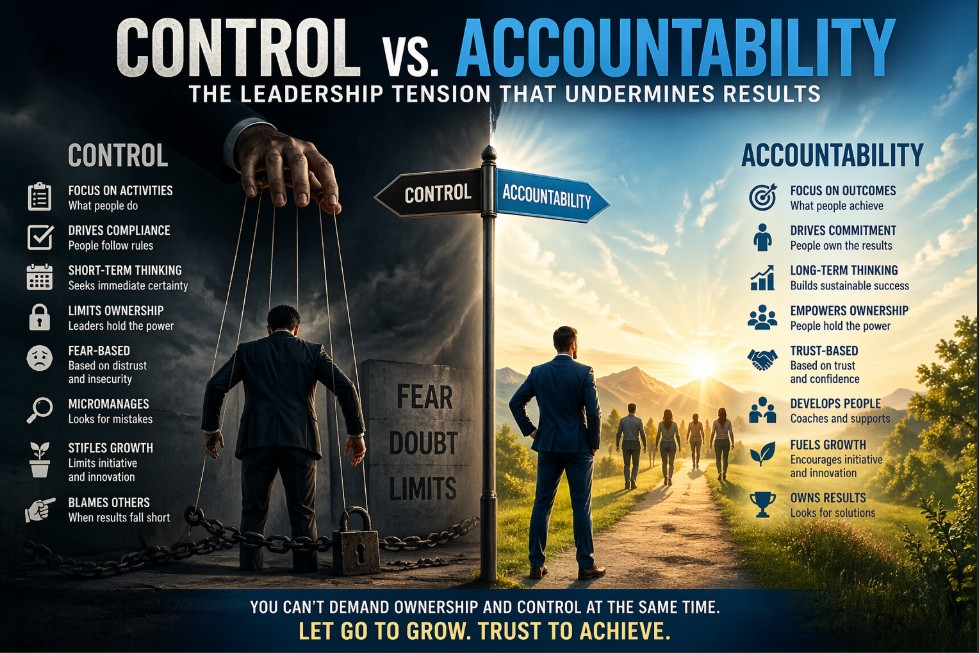
At its core, control and accountability are not the same thing, yet they are frequently confused. Control is about directing behavior, monitoring, checking, and often dictating how work gets done. Accountability, on the other hand, is about owning outcomes, clear expectations, shared goals, and individuals taking responsibility for results. Control says, “Do it this way.” Accountability says, “Own the outcome.” One focuses on compliance, the other on commitment.
The irony is that leaders who lean heavily into control often believe they are strengthening accountability. In reality, they are substituting it.
What Drives the Need to Control?
The inability or unwillingness to relinquish or share power is rarely about process; it is about “leadership psychology”. Control provides certainty. It reduces ambiguity. It gives leaders a sense of safety in environments that are often unpredictable.
But underneath that need for certainty is something deeper: fear, “Yikes”
Fear that others won’t perform at the same level as you.
Fear that mistakes will reflect poorly on you as the leader.
Fear of losing relevance, authority, or status, which could lead to losing my job.
Fear that if I let go, things will fall apart.
For some leaders, especially those with perfectionistic or distrust-oriented tendencies, control becomes a protective mechanism. It is not simply a leadership style; it is a psychological coping strategy. And like many coping strategies rooted in fear, it creates short-term relief but long-term dysfunction. Dysfunction that sadly organizations reward, which reinforces the behavior continuing.
Control as a Barrier to Accountability
Here’s where the breakdown occurs: control stifles the very accountability it seeks to enforce.
When leaders over-direct (micromanage), they unintentionally send a message: “I don’t trust you to figure this out.” Over time, employees adapt. They stop taking initiative. They wait for direction. They defer decisions upward. Not because they lack capability, but because the environment has conditioned them to do so.
Accountability requires ownership, and ownership requires space.
If every decision is second-guessed, every step is prescribed, and every outcome is pre-managed, there is no room for individuals to truly own their work. What you get instead is compliance-driven behavior, people doing just enough to meet expectations, but not enough to exceed them.
Even more damaging, control creates a diffusion of responsibility. When a leader is involved in every detail, it becomes unclear who actually owns the result. And when ownership is unclear, accountability disappears.
The Shift from Control to Accountability
High-performing organizations make a deliberate shift: they move from managing behavior to managing outcomes.
This does not mean the absence of standards, structure, or oversight. It means leaders are clear about “the what” and “the why”, while empowering others to determine “the how”. It means setting expectations, aligning on outcomes, and then stepping back enough for people to rise to those expectations.
Accountability thrives in environments where:
- Expectations are clear and measurable
- Trust is demonstrated, not just stated
- Autonomy is paired with responsibility and rewarded
- Feedback is developmental, not punitive
Leaders who embrace accountability understand a critical truth: you cannot demand ownership while simultaneously controlling every variable.
Leadership Reflection
Control may produce short-term precision, but accountability produces sustainable performance. One limits employees to just executing tasks; the other invites them to lean into ownership of the results.
Key reflection question every leader should ask themselves:
Are you trying to control the work, or develop people who can be trusted to own it the work? You can’t do both!

About Dr. Ollie G. Barnes III
Dr. Ollie G. Barnes III is an organizational performance consultant, keynote speaker, and author of Diagnosing Toxic Leadership: Understanding the Connection Between Personality Disorders and Toxic Leader Behaviors. As the founder of Impact Performance Consultants, he brings over 25 years of experience helping organizations transform workplace culture, improve leadership effectiveness, and build psychologically safe environments. Learn more at ImpactPerformanceConsultants.com