
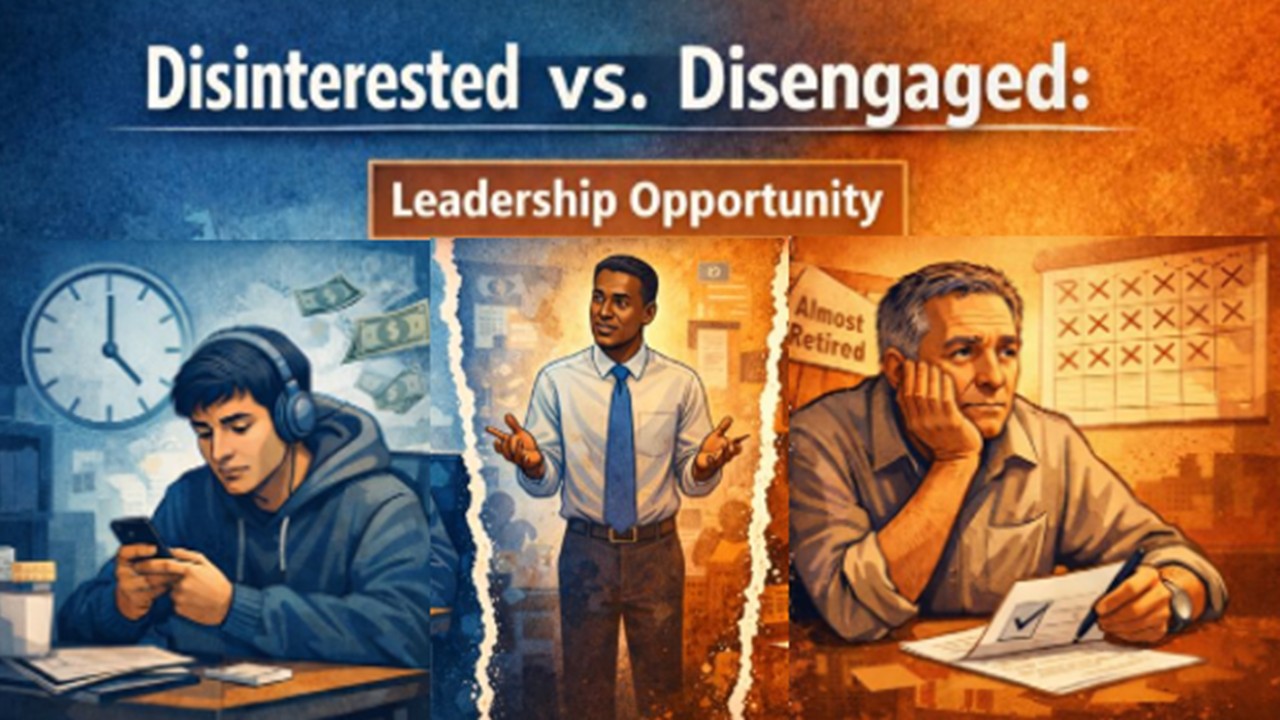
Employee engagement is often discussed as if it were a single problem with a single solution. It isn’t.
In today’s workplace, leaders are facing two very different forms of withdrawal—and confusing them leads to frustration, wasted effort, and poor results.
There is a difference between employees who are disinterested and those who are actively disengaged. One is often new to the workforce or role. The other has been in it for decades. And each requires a very different leadership response.
Disinterested Is Not Disengaged
The disinterested employee is often early in their career, or early in their role.
The job is a paycheck. The work hasn’t yet connected to purpose, growth, or identity.
You’ll hear things like:
- “I’m just here to do what I was hired to do.”
- “It’s fine. It pays the bills.”
- “I don’t really see this as a career.”
These employees often do only what is in front of them. They rarely extend themselves to solve problems that require any of their discretionary energy or time.
This isn’t defiance. It is undeveloped commitment.
In many cases, leaders assume motivation should arrive fully formed. But motivation is often shaped, not discovered.
Leadership Response:
Disinterested employees need clarity, exposure, and relevance.
- Clarify expectations beyond tasks, why the work matters.
- Expose them to pathways: skills they are building, not just hours they are working.
- Make relevance explicit: how today’s work connects to something bigger than a paycheck.
Disinterest is often a leadership invitation, not a failure. These are the employee with the biggest upside because they are often just waiting for leaders to provide them with an opportunity to LEAN IN.
Disengagement Is a Warning Sign
The disengaged employee, on the other hand, is usually not new at all.
This is the employee who has:
- Worked the same job for 20–25 years
- Seen initiatives come and go
- Learned that effort does not always equal reward
- Shifted from pride to protection
They show up. They meet minimum requirements. They “check the box.”
But the energy is gone.
Disengagement does not happen overnight, it is typically the result of broken psychological contracts, such as downsizing employees that have made extreme sacrifice for the organization because they are committed to the company. Ignored contributions, or leadership inconsistency over time.
Leadership response:
Disengaged employees do not need hype. They need acknowledgment and honesty.
- Acknowledge their experience without romanticizing longevity.
- Invite them into contribution, not compliance.
- Have real conversations about what still matters and what no longer does.
Some disengaged employees can be re-engaged.
Others may simply need to exit with dignity.
Skilled leaders understand the importance of applying energy in knowing the difference because they know their work force.
One Size Does Not Fits All
The biggest mistake leaders make is applying the same engagement tactic to everyone.
Pizza parties do not fix cynicism.
Career ladders do not inspire those who feel unheard.
And accountability alone will not create caring.
Engagement is not about forcing enthusiasm.
It is about creating conditions where caring is reasonable again.
What Leaders Must Own
Leaders don’t control how employees feel, but they do control:
- The clarity of expectations
- The consistency of leadership behavior
- The fairness of opportunity
- The psychological safety of speaking up
When employees disengage, the question is not: “What’s wrong with them?”
The question is: “What have they learned about effort, voice, and value here?”
The Bottom Line
Before labeling employees as disengaged, leaders with high levels of self-awareness will pause to examine their own efforts and influence.
Disinterested employees need development.
Disengaged employees need reckoning.
And leaders must stop treating engagement as a personality issue and start treating it as a leadership outcome.
Engagement is rarely about fixing people. It is about leaders being willing to reflect, adjust, and respond with clarity and courage. When leaders respond correctly, engagement is not forced, it’s earned.
Click here to schedule a discussion or a Lunch and Learn for your leaders. Impact Performance Consultants can help your organization create healthy leadership habits.

About Dr. Ollie G. Barnes III
Dr. Ollie G. Barnes III is an organizational performance consultant, keynote speaker, and author of Diagnosing Toxic Leadership: Understanding the Connection Between Personality Disorders and Toxic Leader Behaviors. As the founder of Impact Performance Consultants, he brings over 25 years of experience helping organizations transform workplace culture, improve leadership effectiveness, and build psychologically safe environments. Learn more at ImpactPerformanceConsultants.com